
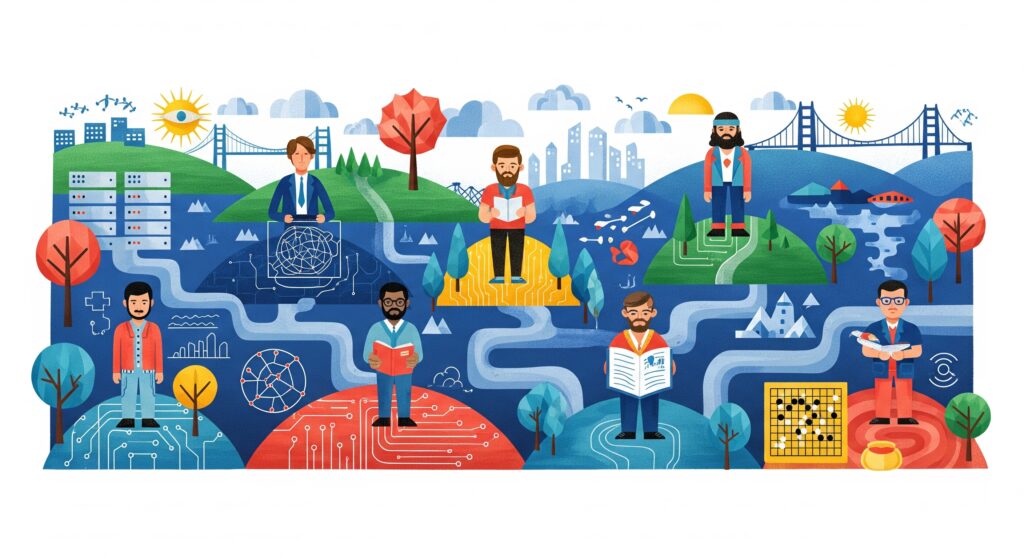
Talking about diversity in AI usually means celebrating women breaking barriers and underrepresented groups finally getting seats at the table. That conversation matters. But here’s what nobody mentions: the men in AI who built the foundations everyone else stands on often get reduced to villain narratives or ignored entirely. These aren’t just tech bros with venture capital – they’re researchers who spent decades being called crazy for believing neural networks could work, CEOs betting their entire companies on technology nobody understood yet, and engineers building the infrastructure that makes every ChatGPT conversation possible.
Today’s Most Influential Male AI Pioneers Leading the Revolution
1. Sam Altman: OpenAI CEO Shaping Generative AI
Sam Altman sees AI as a trillion-dollar opportunity – not in some distant future, but right now. Under his leadership, Reuters reports that OpenAI underwent massive restructuring to chase this vision at unprecedented scale. The company that gave us ChatGPT isn’t slowing down. Its actually accelerating.
What makes Altman different? He calls this moment an “AI tornado” – where technological breakthroughs demand constant adaptation and bold organizational shifts just to stay relevant. His approach involves aggressive scaling and infrastructure expansion and rapid product iteration and decisive partnerships and talent acquisition all happening simultaneously. Christian and Timbers captures his philosophy perfectly: this isn’t about incremental progress anymore.
For anyone starting a career today, Altman’s message is clear. CNBC notes his belief that this is the most exciting time in history to enter AI. But what does that actually mean for someone considering this path? It means joining an industry where the rules get rewritten every six months.
2. Demis Hassabis: DeepMind Leader and Nobel Prize Winner
Demis Hassabis took DeepMind from a London startup to Google’s most important AI acquisition. His AlphaGo beating the world Go champion wasn’t just a publicity stunt – it proved that AI could master tasks humans thought required intuition, not computation. Now he’s tackling protein folding with AlphaFold, potentially saving millions of lives through drug discovery.
The Nobel committee doesn’t hand out prizes for building chatbots. They recognized Hassabis for fundamentally changing how we understand intelligence itself. That’s the real revolution here.
3. Geoffrey Hinton: The Godfather of Deep Learning
Geoffrey Hinton just won the Queen Elizabeth Prize for Engineering in 2025, but honestly, the award is about three decades late. University of Toronto notes this recognition comes for his foundational contributions to deep learning – work he started when most computer scientists thought neural networks were a dead end.
Here’s what drives people crazy about the AI field: everyone celebrates breakthroughs, but nobody remembers the years of being ignored. Hinton championed these ideas through the “AI winter” of the 1990s when funding dried up and colleagues moved on to other problems. His persistence created the foundation for everything from your phone’s face recognition to GPT-4.
4. Yann LeCun: Meta’s Chief AI Scientist and CNN Pioneer
Yann LeCun spent four decades telling everyone that convolutional neural networks would revolutionize computer vision. For most of those years, people thought he was wasting his time. Wall Street Journal describes his career as “visionary persistence” – championing neural networks even when the AI mainstream completely disregarded them.
Now CNN architectures power everything from medical imaging to self-driving cars. Sound familiar?
Recent reports from TechCrunch suggest LeCun might leave Meta to start his own venture. After decades of proving skeptics wrong inside big corporations, maybe it’s time to build something entirely new.
5. Jensen Huang: NVIDIA CEO Powering AI Infrastructure
Jensen Huang turned NVIDIA from a gaming graphics company into the backbone of the AI revolution. Every major AI lab runs on NVIDIA hardware. Every. Single. One.
At COMPUTEX, NVIDIA unveiled Huang’s vision of AI infrastructure becoming a trillion-dollar industry. This isn’t hyperbole – he’s talking about platforms like DGX and BlueField-4 DPUs that make modern AI computation possible. Without this infrastructure, ChatGPT would still be a research paper.
Mintz quotes Huang calling AI “America’s next industrial revolution.” The difference between him and other CEOs making grand proclamations? He’s actually building the factories.
Emerging Leaders Shaping Tomorrow’s AI Landscape
Andrew Ng: Education Pioneer Democratizing AI Knowledge
Andrew Ng made AI education accessible to millions through Coursera. While others built models, he built classrooms. His machine learning course has trained more AI engineers than every university program combined. Think about that impact for a second.
Elon Musk: xAI Founder Building Superhuman Infrastructure
Elon Musk’s xAI launched Grok to compete with ChatGPT, but that’s not the interesting part. He’s building massive compute clusters in Memphis – the kind of infrastructure that makes training next-generation models possible. Love him or hate him (and plenty do both), he’s pushing the boundaries of what’s computationally feasible.
Kai-Fu Lee: Bridging Asian and Western AI Innovation
Kai-Fu Lee sees something most Western tech leaders miss: China’s AI development benefits everyone. As founder of 01.AI, Stanford notes his emphasis on how competition drives innovation and collaboration creates breakthroughs.
Exponential View captures Lee’s post-ChatGPT predictions: increased joint ventures between Eastern and Western firms as AI becomes ubiquitous. He’s not just predicting this future – he’s actively building the bridges to make it happen.
Mustafa Suleyman: Microsoft AI Chief Advancing Human-Computer Interaction
Mustafa Suleyman wants AI that empowers people, not replaces them. At Microsoft, Microsoft AI reports his focus on “humanist” AI – technology that enhances human capacity rather than competing with it.
His work on products like Copilot shows this philosophy in action. Mustafa Suleyman states his mission clearly: AI should make people more creative and capable, not obsolete. After co-founding DeepMind and leading AI at Google, he’s now betting Microsoft’s future on this human-centric approach.
The Future of AI Leadership
These male AI pioneers aren’t just building technology – they’re defining what intelligence means in the 21st century. From Hinton’s decades-long fight for neural networks to Altman’s trillion-dollar vision, from Huang’s infrastructure revolution to Lee’s East-West bridges, these influential men in artificial intelligence share one trait: they bet everything on ideas others called impossible.
The next chapter of AI won’t be written by any single genius or gender or geography. But understanding where we’re going requires acknowledging who got us here. These men didn’t just ride the AI wave. They created it